Welcome to Fulxing Intelligent - SMT Automation Equipment
 简体中文

Customer Service Hotline
18565526634
Welcome to Fulxing Intelligent - SMT Automation Equipment
18565526634
Contact: Mr. Yang
Mobile: 18565526634
Tel: 18565526634
Email: 1404870852@qq.com
Address: Songyu Rd 142, Songgang St, Bao'an Dist., Shenzhen, China
The usual industry rule of thumb puts annual maintenance for a vertical insertion machine at 5 to 8 percent of the purchase price. On a $60,000 machine that reads as $3,000 to $4,800 a year, which sounds manageable. The reason the range is that wide is simple: one plant spends twelve hundred a year on the same model another plant spends six thousand on, and the difference is not luck.
Start with the part you cannot avoid.
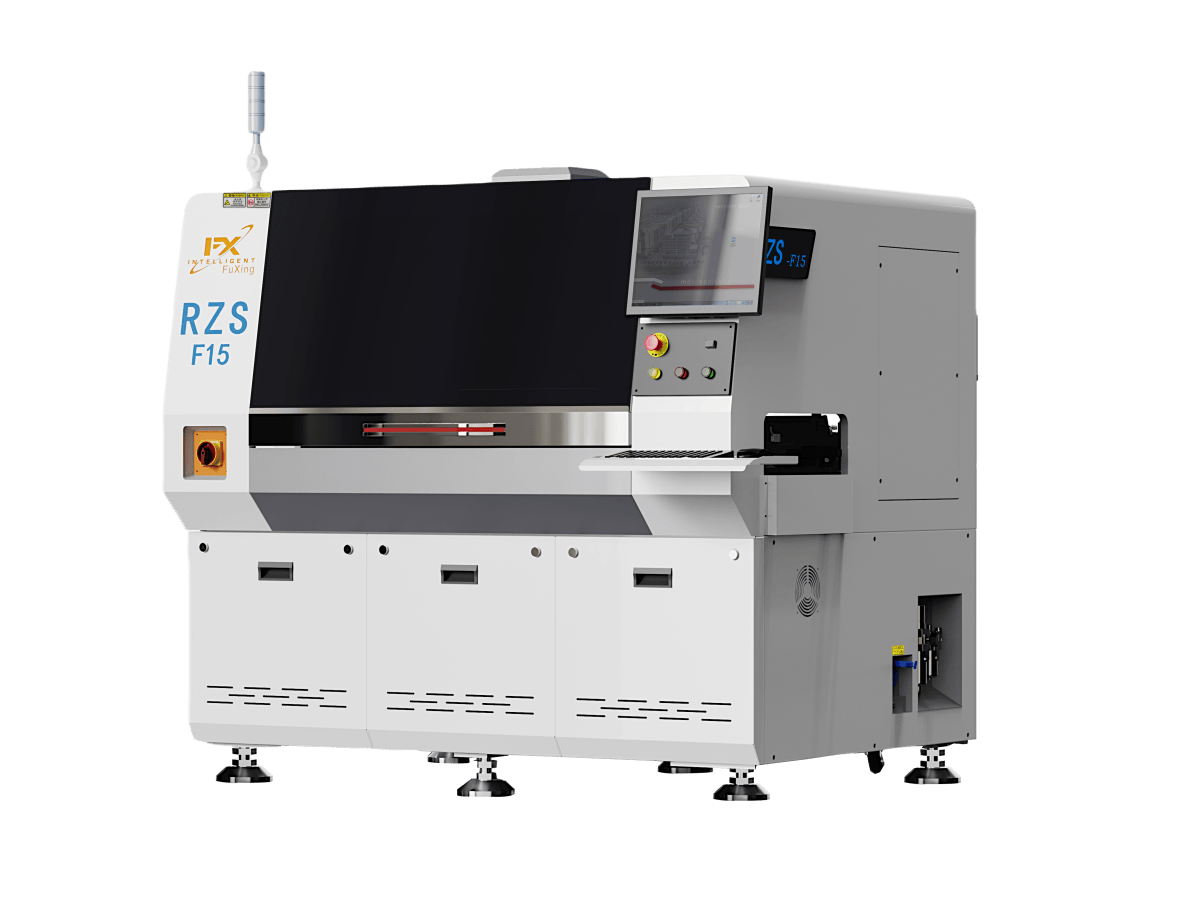
Consumables are a hard cost. They follow output, not budget discipline. Cutting blades, gripper fingers, feed belts, springs, sensors. Two-shift operations go through two or three sets a year without trying. The table below estimates a single-shift schedule; prices vary by supplier and region, but the magnitudes hold.
| Consumable | Replacement cycle (1 shift) | Typical price | Keep in stock |
|---|---|---|---|
| Cutting blades | 3–6 months | $40–110 per set | 2 sets |
| Insertion grippers | 6–12 months | $70–200 each | 2 |
| Feed belts | ~12 months | $12–30 each | 4 |
| Compression springs | 6–12 months | $3–9 each | 10 |
| Component sensors | 2+ years, replace on failure | $30–85 each | 2 |
| Specified grease | Top up monthly | $30–55 per tube | 2 |
Total consumables land somewhere between $1,100 and $1,700 a year on one shift. That is the floor. Push below it and you are trading yield for savings.
Two softer lines sit on top: an annual service contract, which some suppliers bundle into warranty and others charge $700 to $1,400 for, and spare parts inventory. The inventory is not money spent. It is working capital sitting on a shelf, and $2,000 to $3,000 covers the common items.
None of the above includes a stopped line, because downtime never appears on a purchase order. It is still the largest line item.
Run the numbers once. Take the daily insertion volume of one line, convert it into the processing fee per board or the outsourced equivalent, add late-delivery exposure. For a mid-sized plant, one lost day is $3,000 to $5,000 without much effort. A single three-day wait for a part costs more than two years of consumables.
Which makes one common savings strategy a net loss: buying parts only when something breaks. Lead time for imported parts runs three to five days at best, two to three weeks for slow movers. The line sits idle the whole time, and the inventory money you avoided does not cover the interest on the delay.
There is also a quality gap inside the same part number. OEM cutting blades and aftermarket blades can differ by 100 percent in price. Both work fine for two months. By the third, the aftermarket edge dulls faster, lead lengths start drifting, insertion depth follows, and nothing on the machine throws an alarm. The failure mode is quiet: insertion machine spare parts start getting replaced more often, and the total cost ends up higher. The practical split is OEM for parts that touch the component, aftermarket for general hardware.
This section matters more than the arithmetic, because most plants have done at least one of these.
Wrong grease on the rails. Someone grabs a general-purpose can, the rail looks lubricated, and the grease turns into an abrasive paste. An insertion shop floor is full of lead trimmings and solder dust. Sticky grease collects it and grinds it into the rail every cycle. Use the specified lubricant, once a month, no more.
Compressed air on the vision lens. It feels routine. It does not remove the oil film, and it can scratch the coating. Lens tissue, weekly, more often in shops with heavy flux smoke.
Taking the insertion head apart in-house. Disassembly is easy. Getting 0.01mm accuracy back is not, because that accuracy comes from assembly relationships and calibration, not from tightening bolts. Let the supplier handle it, especially inside warranty where the visit is free.
One more, harder to spot: adjusting parameters instead of investigating mechanics. A machine starts inserting crooked, someone dials in a compensation value, and the problem disappears for a while. It reappears all at once when the compensation runs out of room. Insertion machine maintenance goes wrong fastest through this route.
Take a mainstream vertical insertion machine running 80,000 insertion points a day on one shift.
Consumables and supplies around $1,300. Annual service around $850. Spare parts on the shelf $2,500, which is capital rather than expense. Actual annual spend: roughly $2,100, about 4 percent of the machine price. Two shifts doubles the consumables and pushes it to $3,400, still inside the same band.
Now compare the risk side. A servo or ball screw overhaul runs $3,000 to $7,000. A crash that damages the insertion head clears $1,500. Three days of stopped production, $10,000. Maintenance is not about turning $2,100 into $1,100. It is about scheduling that $2,100 so the other numbers never appear.
The schedule has three layers and no cleverness: clean the table and feed tracks at end of shift, clean rails and lenses weekly, verify insertion depth and position against a calibration board monthly. Operators handle the first two. The third needs a technician. Hold all three and the machine keeps its accuracy for seven or eight years. Skip them and year three starts producing a steady stream of small problems.
Common parts and pricing sit in our spare parts section. If you are unsure what to stock for your model and volume, send the details through our contact page and we will put together a list for your actual duty cycle.
Q1: How much does vertical insertion machine maintenance cost per year?
On one shift: $1,100 to $1,700 in consumables and supplies plus $700 to $1,400 for service, so around $2,100 total, roughly 4 to 5 percent of the machine price. Two-shift operation doubles the consumables portion.
Q2: Do consumables have to be OEM?
Depends on the part. Cutting blades and grippers affect insertion accuracy and lead quality directly, so OEM is worth it. Belts, springs and seals are fine aftermarket if you replace them on schedule rather than on failure. Sensors vary by model.
Q3: How often should accuracy be calibrated?
Verify insertion depth and position with a calibration board monthly, with a deeper check quarterly. Above 100,000 points a day, move the verification to every two weeks.

Copyright © 2002-2026 Shenzhen Fulxing Intelligent Equipment Co., Ltd. All rights reserved. ICP License:
Service Hotline