Welcome to Fulxing Intelligent - SMT Automation Equipment
 简体中文

Customer Service Hotline
18565526634
Welcome to Fulxing Intelligent - SMT Automation Equipment
18565526634
Contact: Mr. Yang
Mobile: 18565526634
Tel: 18565526634
Email: 1404870852@qq.com
Address: Songyu Rd 142, Songgang St, Bao'an Dist., Shenzhen, China
A mainstream vertical insertion machine is rated at 0.16 seconds per insertion point, roughly 20,000 points an hour. Most buyers see that number. Fewer sit down and work out what it means for their own line: how many points do I insert in a day, and how many machines does that require?
Getting this wrong is expensive in both directions. One machine too many means a six-figure asset sitting idle while depreciation and service costs keep running. One too few means permanent overtime, outsourced volume and blown delivery dates.
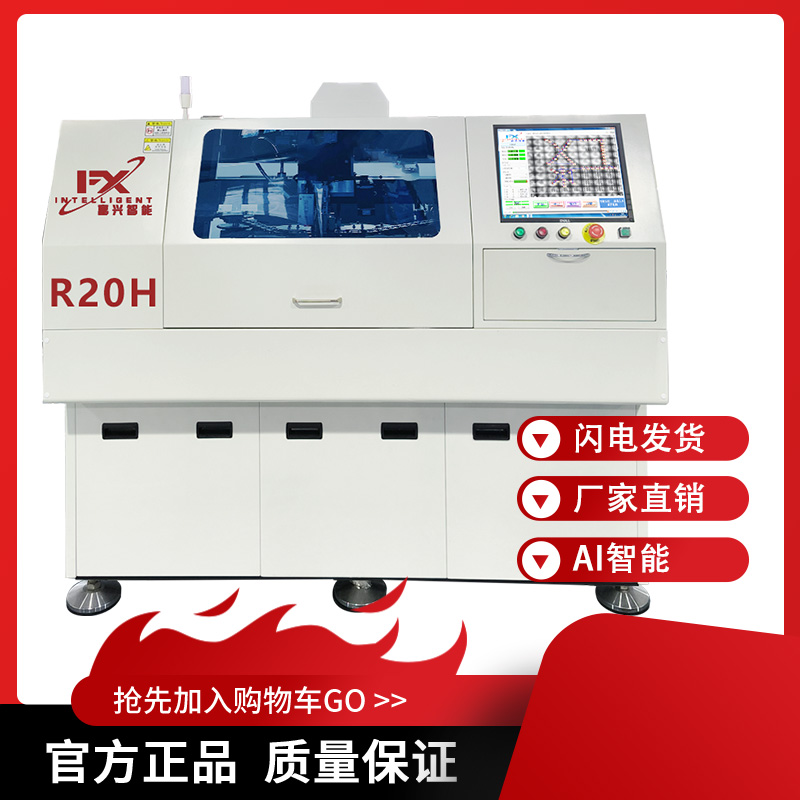
The arithmetic is simple. The difficulty is in the parameters.
Points, not boards. One through-hole component inserted into one hole is one point.
Multiply points per board by daily output. A power supply board with 180 insertion points, run at 600 boards a day, comes to 108,000 points. Two shifts doubles it.
One clarification that trips people up: SMT parts do not count. Count only the through-hole components that go through wave soldering, meaning resistors, capacitors, diodes, jump wires, connectors and terminals. One hole, one point.
That 20,000 points per hour assumes full feeders, no faults, no changeover and no stoppages. Shop floors do not run that way.
Real capacity needs a utilization factor. An eight-hour shift loses time to feeder reloads, changeovers, jam clearing, daily checks and handover. Six hours of actual running is respectable management.
| Actual run time per shift | Utilization | Effective daily capacity | Typical situation |
|---|---|---|---|
| 7 hours | 88% | ~140,000 points | Single product, high volume, tight management |
| 6 hours | 75% | ~120,000 points | Common, one changeover a day |
| 5 hours | 63% | ~100,000 points | Mixed production, three to four changeovers |
| 4 hours | 50% | ~80,000 points | Complex components, frequent changeovers, new operators |
There is also hidden loss: dropped components and re-insertion. Even a stable machine drops a small percentage, and those points get filled by hand. The volume is small but the time is real, especially with leads that arrive bent.
Back to the example. 108,000 points a day, against 120,000 points of machine capacity on one shift.
108 divided by 120 is 0.9. One machine covers it, with ten percent headroom, which is no headroom at all. Equipment needs maintenance, orders fluctuate, and running at 90 percent load means every bad week becomes a crisis.
Real configurations apply a factor of 1.2 to 1.5. In this case, 1.2 gives 1.08, still essentially one machine. 1.5 gives 1.35, which means either two machines or one machine plus an outsourcing plan for peak periods.
| Daily points (one shift) | Machines required | Recommended setup | Note |
|---|---|---|---|
| Under 80,000 | 0.7 | 1 machine | Comfortable margin, can take rush orders |
| 80,000–120,000 | 0.7–1.0 | 1 machine + overtime plan | Tight, avoid promising urgent delivery |
| 120,000–220,000 | 1.0–1.8 | 2 machines | One primary, one for peaks |
| 220,000–350,000 | 1.8–2.9 | 3 machines | Consider a linked-line setup |
| Above 350,000 | 3+ | Linked production line | Stacking single machines stops paying off |
This table assumes 0.16-second cycle time and six effective hours per shift. Boards with unusually high point counts, or with very mixed component types, drop one row.
Plenty of plants work out the machine count, place the order, and then discover the bottleneck was never the inserter.
Behind the inserter sits the wave soldering machine. One wave solder line can absorb the output of two or three inserters. With only one wave solder line, capacity caps there and a second inserter just queues up. If wave soldering has spare capacity and the inserter is short, that is a genuine equipment gap.
Ahead of the inserter sits material. Feeder station count sets how many component types load at once. When a board carries more types than the machine has stations, production stops mid-run to swap reels. Fifteen minutes each time, several times a day, and capacity falls off a cliff. Send the BOM component count to the supplier during selection and have them calculate the station requirement. That question matters more than the speed rating.
Then changeover. Mixed-production plants switch products three or four times a day, and every changeover removes time that never appears in capacity figures. That is why the table above shows only five effective hours for frequent changeover.
Buying too many is easy to calculate. A vertical insertion machine at $60,000, sitting idle, depreciates $12,000 a year over five years, before floor space, service and capital cost. Idle machines also lose accuracy.
Buying too few is harder to quantify and hurts more. Overtime, outsourced processing, late delivery penalties, customers who do not come back. None of it shows up on a purchase order. All of it shows up in the P&L.
A reasonable approach: buy at 1.2 times calculated need, and choose a model that supports linking. When peak season arrives, add an identical unit rather than buying an oversized machine up front, which also avoids retraining operators.
The calculation is not the hard part. Using realistic parameters is. Brochure capacity comes from a perfect run. The question worth asking is narrower: with my board, my batch size and my changeover frequency, what do you measure in a live run? Answer that, and the table above means something.
Send your BOM and daily output through our contact page if you want the numbers worked out for your own boards.
Q1: How many points can a vertical insertion machine do in a day?
Around 120,000 points on one shift at six effective hours, or roughly 240,000 across two shifts. These figures already exclude feeder reloads, jam clearing and inspection time.
Q2: How do I work out how many machines I need?
Three steps: points per board times daily output, divided by the machine's effective capacity at your real utilization, then multiply by 1.2 to 1.5 for margin. Round up.
Q3: If capacity falls short, should I buy another machine or raise utilization first?
Check utilization first. If you are only running four or five effective hours, the constraint is changeover, material shortage or breakdowns, and a new machine just scales the waste. Add equipment once utilization is above seventy percent and still short.

Copyright © 2002-2026 Shenzhen Fulxing Intelligent Equipment Co., Ltd. All rights reserved. ICP License:
Service Hotline