Welcome to Fulxing Intelligent - SMT Automation Equipment
 简体中文

Customer Service Hotline
18565526634
Welcome to Fulxing Intelligent - SMT Automation Equipment
18565526634
Contact: Mr. Yang
Mobile: 18565526634
Tel: 18565526634
Email: 1404870852@qq.com
Address: Songyu Rd 142, Songgang St, Bao'an Dist., Shenzhen, China
The specification page is the one the supplier wants you to read first: speed, accuracy, capacity. Those three lines always look good. What decides whether an automatic insertion machine can actually run your boards is usually a different set of numbers. Some sit on the back of the brochure. Some need a follow-up question. Some make the salesperson change the subject.
The twelve below are ordered by where buyers actually get caught, not by importance. You can ask them in another order, but change the sequence and some of the questions stop landing.
Repeat positioning accuracy and positioning accuracy are not the same thing. The 0.01mm figure in most brochures refers to repeat positioning: how consistently the head returns to the same spot. Positioning accuracy is the absolute question, whether it reaches the commanded coordinate on the first try.
On an automatic insertion machine, repeat positioning is what you care about. Ask it concretely: over a thousand consecutive insertions, what does the spread of position error look like, and what is the maximum deviation. A supplier who answers that has the data. A supplier who repeats "our accuracy is 0.01" usually has not measured it.
Cycle time works the same way. 0.16 seconds per point is measured at the shortest span, the lowest component profile and the best possible program order. Your board carries tall electrolytic capacitors and long leads that sit unevenly, so real cycle time is slower. The useful question is: insert my board on your demo machine, tell me the measured seconds per point, and tell me whether it drifts after two hours of running.
Drift itself is information. A machine that ran 0.16 seconds for six months and now runs 0.2 seconds has worn drive components. That is a maintenance signal, not a sales figure.
Feeder station count is the most commonly underestimated number. Stations equal the component types you can load at once. A customer in Cixi building appliance boards had 31 component types on the BOM and bought a machine with 20 standard stations. Three reel changes a day, each one costing a dozen minutes, and the daily output dropped by a visible margin.
Ask two figures, not one: how many stations standard, and how far it can be expanded. A supplier who only quotes standard is not leaving you headroom.
Span range has to be checked against your BOM. Insertion heads on vertical and odd-form machines typically span 0.4 to 1 inch between lead centers. Components outside that range will not insert. Send the maximum and minimum lead spacing from your BOM and ask for written confirmation of the limits. "It handles everything" is not a limit.
Component height is the figure most often understated. Whether a 25mm electrolytic capacitor or a relay with a plastic housing clears depends on head travel and gripper opening. One customer in Zhongshan skipped this question; the machine arrived, the relay did not fit, and that part of the build went back to manual insertion.
Feeding formats come next. Tape is the baseline. Ask whether tube, tray and vibratory feeding can be fitted, and whether they are standard or optional. Plants with many variants should ask what a packaging format change costs: does it need an added module, and how much.
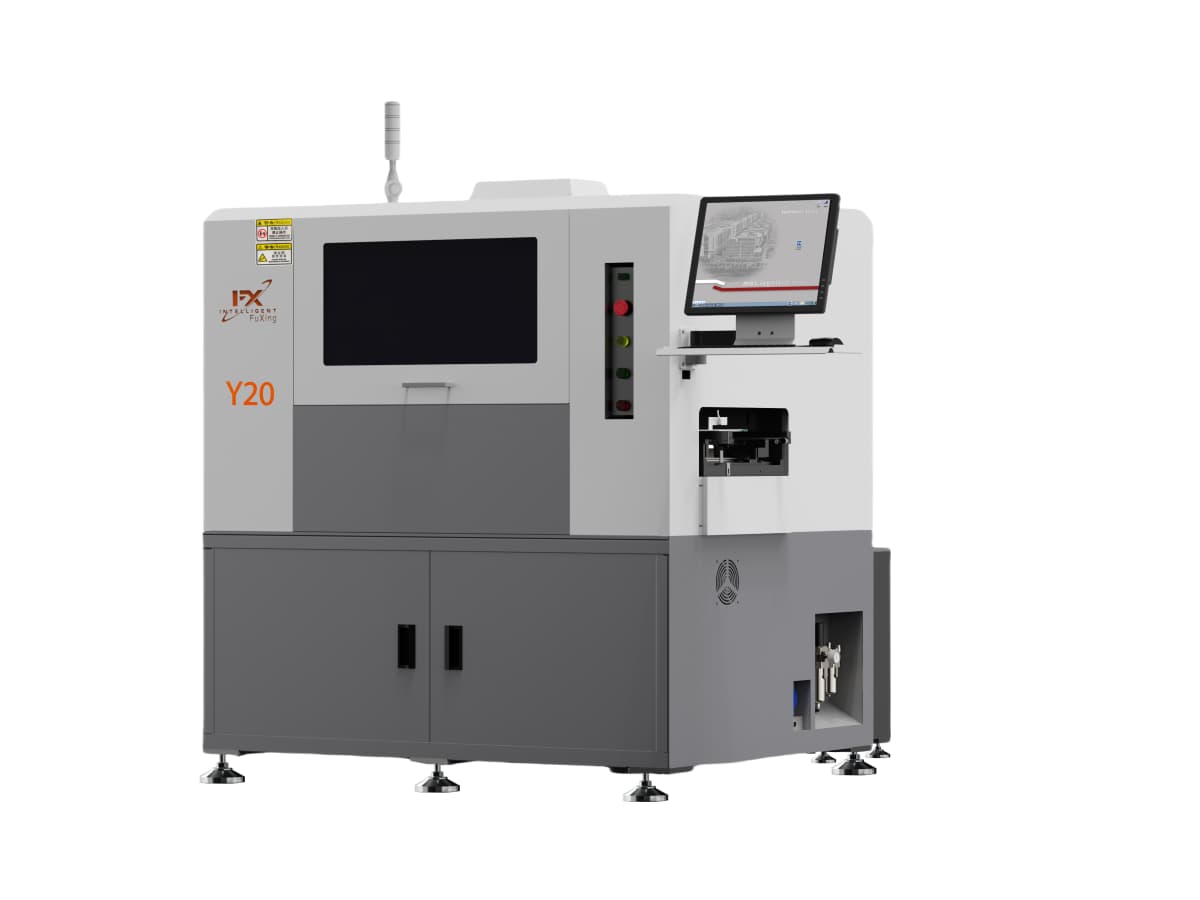
Ask for the PCB size limit at both ends. Some machines handle large boards without trouble but cannot clamp a small one. Whether rail width adjusts by servo or by hand matters a great deal in a high-mix shop: with servo you type a dimension, with manual adjustment you measure it every time.
Floor space is the figure brochures shrink most. Two square meters usually covers the machine body alone. Add the infeed and outfeed conveyors, the material staging area and room for an operator, and the real footprint is three to four square meters. Weight matters for floor loading on an upper storey, and that should be checked before delivery, not after.
Air and power get skipped in most insertion machine specifications. Typical requirements are 0.5 to 0.6MPa of stable air pressure and 1.2 to 2kW. In a shop with unstable line pressure, insertion force drifts, and shallow or angled insertions trace straight back to it.
Program storage. A few hundred programs and tens of thousands of programs are two different ways of working. With storage, a product run before is recalled, the Mark point and board origin adjusted, and production resumes. Without it, every changeover means programming from scratch. High-mix plants treat this as a hard requirement for good reason.
Alarm coverage. Missing component, wrong component, missed insertion, reversed polarity, jammed feeder: can all five be detected, and does detection stop the machine or just flash a light? An alarm that only flashes is close to no alarm. The operator turns away and a board is scrapped.
Communication interface. Whether the machine connects to MES or ERP, and whether insertion data, reject rate and machine status can be exported. Customer audits raise this question noticeably more often than they did a few years ago.
No need to memorize them. Print the list and work through it. The line you cannot get an answer to is where the cost will land later.
Once the parameters are settled, one question remains: are these figures for a production unit or for a demo unit.
Demo machines are tuned. Production units are not always identical. Put the critical items into a contract annex: accuracy, cycle time, defect rate, with acceptance criteria and the test method written down. Parameters in a contract carry weight. Parameters in a brochure do not.
Published specifications across our range are listed in the insertion machine section. Consumable and spare part pricing sits in spare parts, and folding that in gives you a five-year cost rather than a purchase price.
Q1: What accuracy should an automatic insertion machine have?
Mainstream automatic insertion machines hold 0.01mm repeat positioning accuracy with defect rates under 0.3 percent. Semi-automatic models are typically ±0.1mm. Confirm which definition is being quoted, since repeat positioning and positioning accuracy are different measurements.
Q2: How many feeder stations are enough?
Count the component types on your BOM. Twenty types need at least twenty stations to leave headroom. If the mix changes often or you want room to expand, size at thirty or more. Too few stations forces frequent stops for reel changes, which eats daily capacity directly.
Q3: Are brochure specifications enough to buy on?
No. Brochure figures describe a demo unit, and a production machine has to be accepted against a contract. Put accuracy, cycle time and defect rate into a contract annex, and agree that acceptance testing happens on your own board. That is an enforceable commitment.

Copyright © 2002-2026 Shenzhen Fulxing Intelligent Equipment Co., Ltd. All rights reserved. ICP License:
Service Hotline