Welcome to Fulxing Intelligent - SMT Automation Equipment
 简体中文

Customer Service Hotline
18565526634
Welcome to Fulxing Intelligent - SMT Automation Equipment
18565526634
Contact: Mr. Yang
Mobile: 18565526634
Tel: 18565526634
Email: 1404870852@qq.com
Address: Songyu Rd 142, Songgang St, Bao'an Dist., Shenzhen, China
A customer making power supply boards called last week. Four people inserting by hand, 40,000 points a day, and he cannot keep the positions filled. He wanted to move to an automatic insertion machine and had about $12,000 in mind.
That budget buys semi-automatic. Fully automatic starts near $45,000. The three-to-five-times gap is real, but it is rarely the number I open with. The first question is simpler: how does the board get to this machine from the previous station now?
The answer usually picks the machine type on its own.
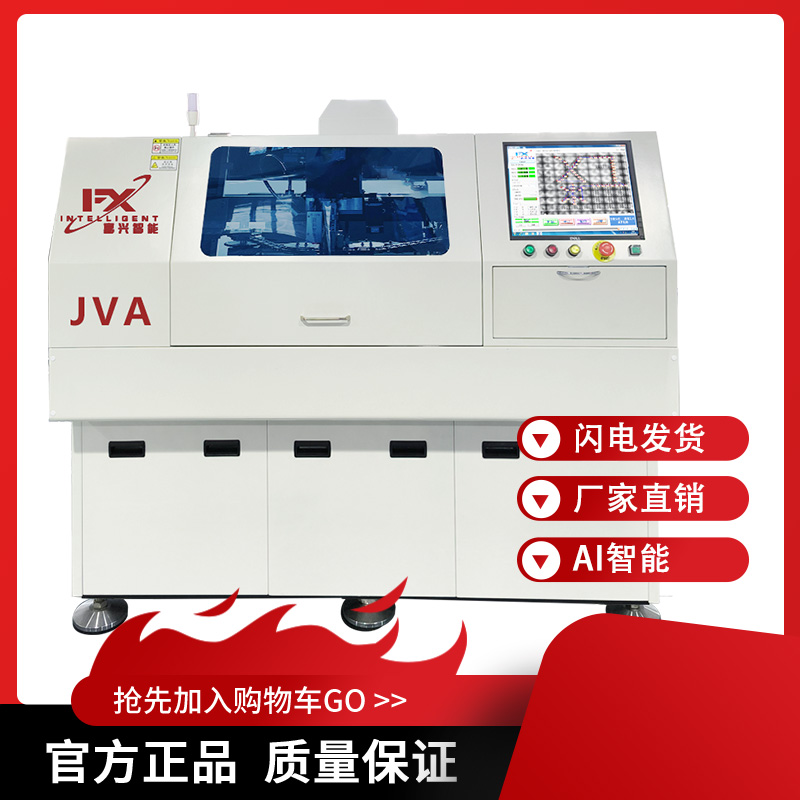
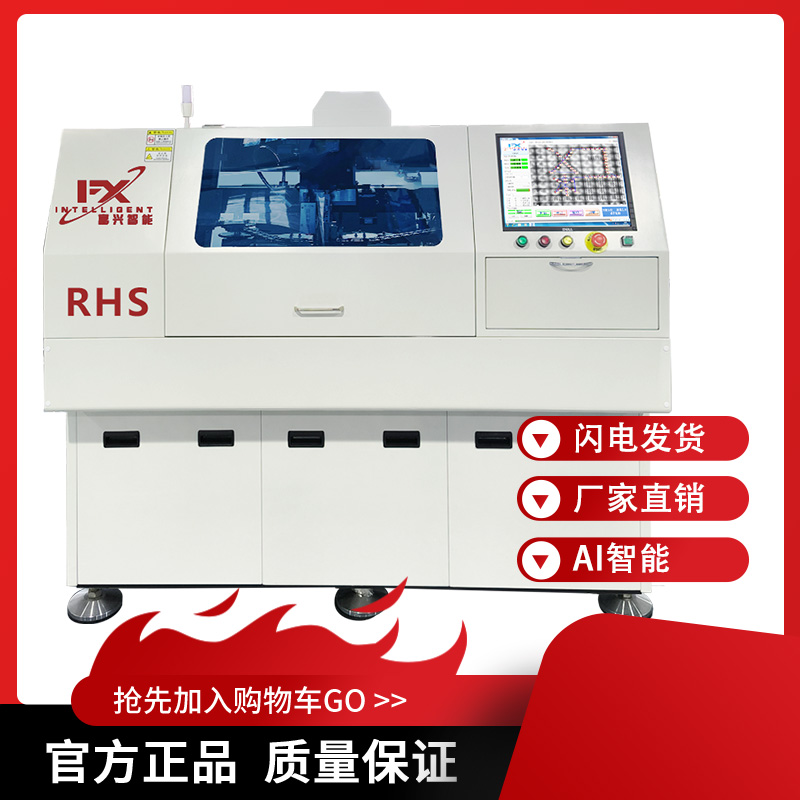
Here is the plain version. A semi-automatic insertion machine has no conveyor and no automatic board loader. When a board is finished, it does not travel to the next station by itself. Someone reaches in, lifts it off, and sets the next one down.
The sequence looks like this. The operator places the PCB on the worktable or in the fixture, locates it on the tooling pins, clamps it, and presses start. The machine separates a component from the tape, aligns it over the hole, presses it in, cuts the lead, and moves to the next point. When the board is done, the machine stops, the operator unloads and loads the next board.
That is what the "semi" means: the loading and unloading loop stays with the operator, and so does watching the run. You cannot walk away while it inserts. A bent lead, a jammed feeder or a reversed component needs someone to see it and stop the cycle.
One warning before you compare quotes. Machines sold as semi-automatic come in two levels. One level feeds components from tape automatically and leaves only board handling to the operator. The other requires the operator to place each component into a locating position by hand, with the machine only pressing and cutting. The second type is cheaper, sometimes under $4,000, and only marginally faster than hand insertion. Ask which one you are being quoted: board loading only, or board loading plus component placement.
Accuracy lands around ±0.1mm and cycle time runs one to two seconds per point. That does not sound fast, but with two or three operators it covers 20,000 to 30,000 points a day, and the defect rate is well below hand insertion.
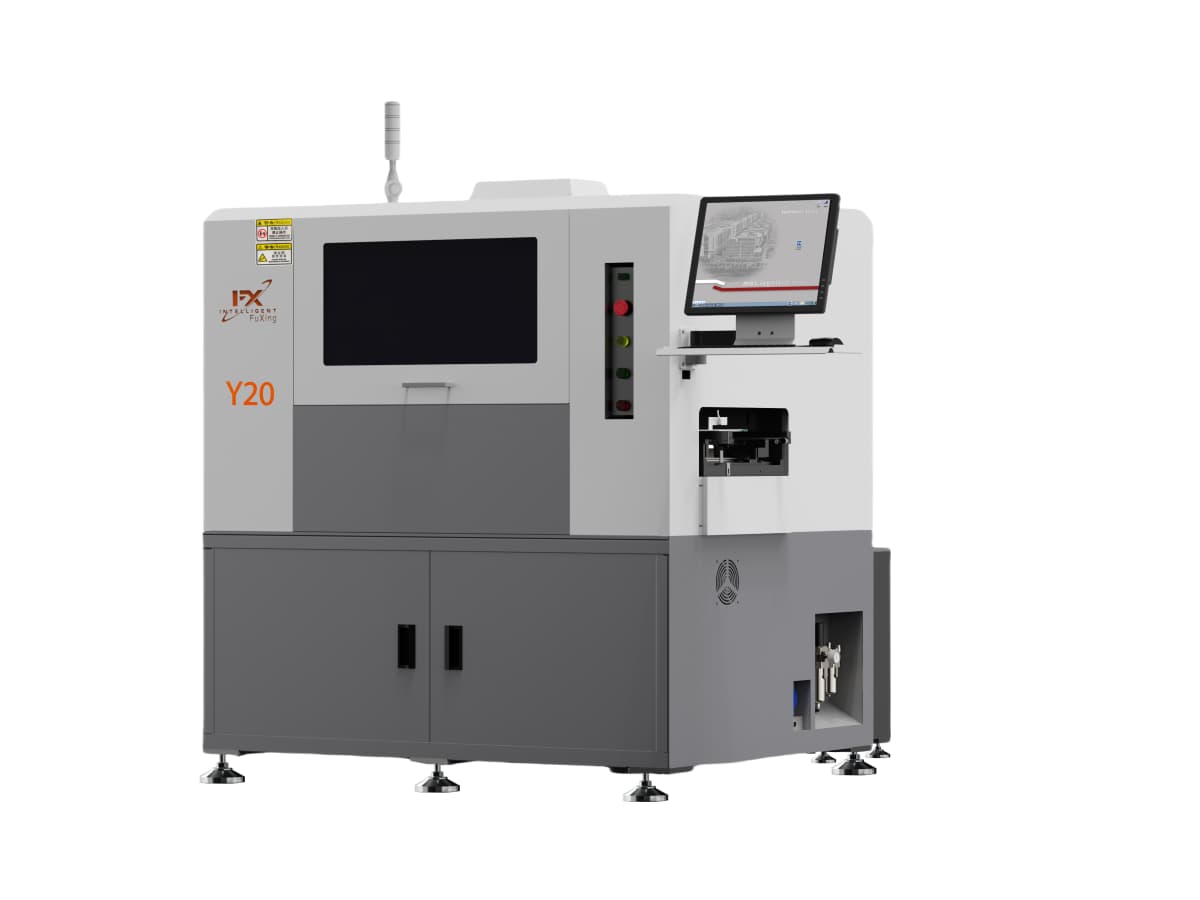
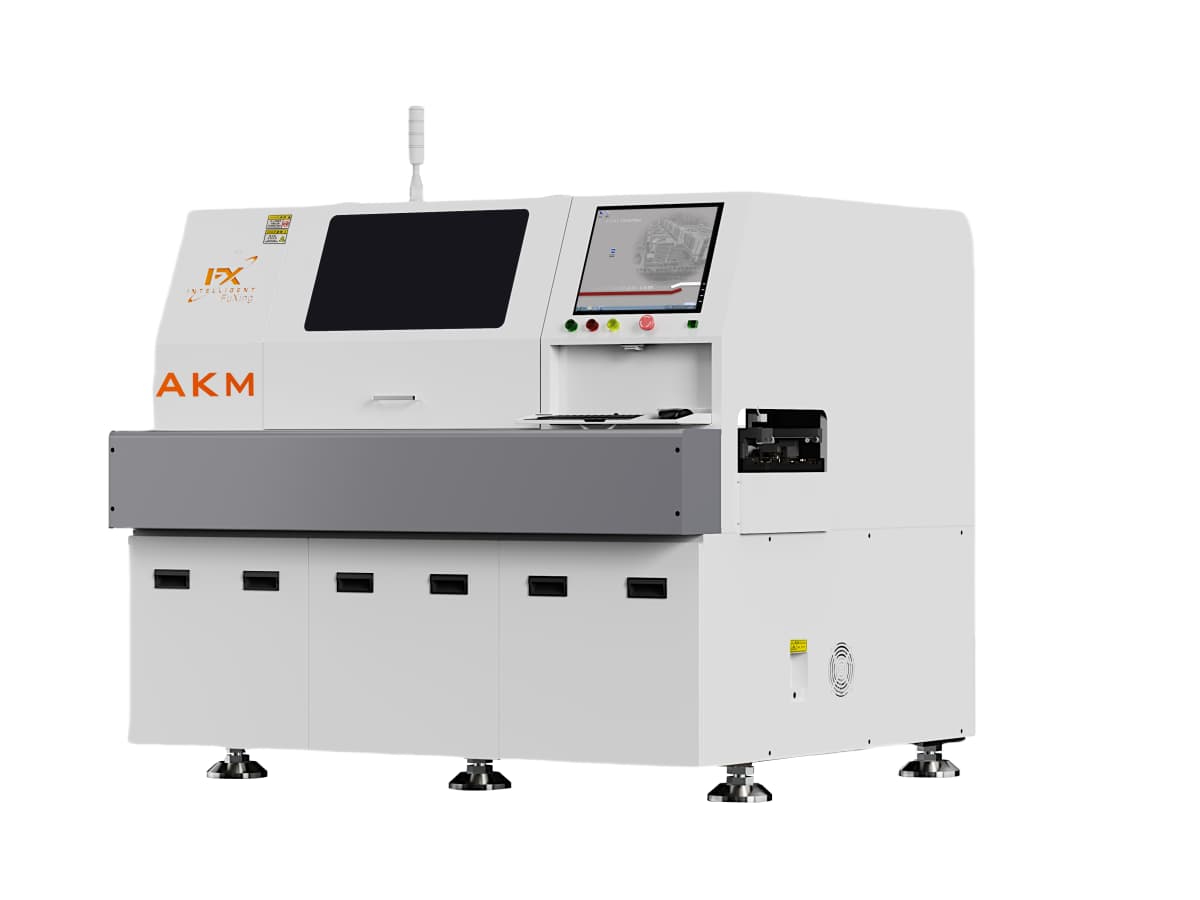
On a fully automatic insertion machine, board handling disappears from the job. A transfer conveyor feeds the board in, the rail width adjusts automatically, vision finds the Mark point, and the head runs the program. When the board is complete it flows out. Tape, tube, tray and vibratory feeding switch automatically, so a board with dozens of component types can run in one pass.
The operator's work becomes reel changes, replenishment, clearing alarms and first article checks. One experienced person supervises two or three machines. That is the real difference from semi-automatic, more than speed: the job itself changes.
Published figures for mainstream models are 0.16 seconds per point, a little over 20,000 points an hour, 0.01mm repeat positioning accuracy, and defect rates under 0.3 percent with vision inspection.
Take a board with 200 points. At 1.5 seconds per point, semi-automatic spends five minutes inserting, plus forty seconds to a minute for loading, clamping and unloading. Fully automatic inserts in under a minute, but reel changes and setup spread across each board add their own cost.
On long runs the automatic machine wins easily. On short runs semi-automatic often comes out ahead, because a changeover is a fixture swap and half an hour of adjustment. An automatic machine needs a program change, feeder changes and rail adjustment, which is one to two hours even for someone who knows the machine.
Defect rate deserves more attention than it usually gets. Hand insertion runs 0.8 to 1.5 percent, semi-automatic around 0.5 percent, fully automatic under 0.3 percent. Reworking one board costs ten or more times the components on it, and it consumes labor and station time as well. At 100,000 boards a year, half a percentage point of defect rate means 500 boards through rework. That bill is usually larger than the electricity and air savings put together.

The calculation is plain: annual labor saved divided by machine price.
A skilled insertion operator costs $9,000 to $12,000 a year fully loaded, including benefits, meals and supervision. Semi-automatic replaces two to three of them, so a $12,000 machine returns in about eighteen months. That is why the category survives in smaller plants.
Fully automatic replaces ten to twelve. A $45,000 machine that saves eight operators shows payback inside eighteen months on paper. The condition is that the order book keeps it busy.
Effective capacity for one automatic machine is roughly 120,000 points a day. Below 100,000 points a day, the machine waits half the time. While it waits it depreciates, occupies floor space and holds up capital, and payback doubles or never arrives.
So two numbers belong in the decision before signing: whether daily point count supports one machine, and whether orders are stable across the year. If either fails, semi-automatic first, or a compact automatic model around two square meters of floor space, is the safer entry. Capacity figures in our insertion machine section can be matched against your own point count.
Under 30,000 points a day, many variants, small batches, limited budget: semi-automatic. Fitting full automation at that volume is using artillery on mosquitoes.
Over 100,000 points a day, a product mix that stays put for years, and a wave soldering line downstream: go fully automatic. Labor cannot keep up at that volume, and customer audits ask about automation level regardless.
In between, both routes work. Semi-automatic first and full automation once orders settle, or a compact automatic model that skips the middle step.
Few buyers ask this, and most remember it later.
Semi-automatic has a ceiling built in. Output is limited by how fast a person can load boards. More volume means more stations and more people, and management cost climbs faster than output.
An automatic machine scales along a defined path: more feeder stations, more insertion heads, transfer conveyors, or two identical units linked into a small line. The equipment grows with the order book.
The gap between those two paths becomes obvious the moment you are using an automatic insertion machine to replace manual insertion and push capacity up another step.
If you are unsure which type fits your board, send the BOM and daily output through our contact page. Machine type and payback can be worked out from those two inputs more accurately than from any brochure.
Q1: How much more does a fully automatic insertion machine cost than a semi-automatic one?
Semi-automatic models run $7,000 to $15,000, with simple single-point versions under $4,000. Fully automatic starts around $45,000 and reaches $120,000 with full vision and multi-station feeding. The gap comes mainly from the feeding system, vision positioning and control architecture.
Q2: Should a small factory buy semi-automatic or fully automatic?
Look at daily point count. Under 30,000 points, semi-automatic returns faster. Above 100,000 points, only full automation keeps up. In between, start with semi-automatic or a compact automatic model at a lower entry price.
Q3: How many automatic insertion machines can one operator supervise?
Two to three on mainstream models, depending on how often reels need changing and how many alarms come up. Boards with many component types and several reel changes per shift realistically mean one machine per operator. That is also why feeder station count has to be sized correctly at selection.

Copyright © 2002-2026 Shenzhen Fulxing Intelligent Equipment Co., Ltd. All rights reserved. ICP License:
Service Hotline