Welcome to Fulxing Intelligent - SMT Automation Equipment
 简体中文

Customer Service Hotline
18565526634
Welcome to Fulxing Intelligent - SMT Automation Equipment
18565526634
Contact: Mr. Yang
Mobile: 18565526634
Tel: 18565526634
Email: 1404870852@qq.com
Address: Songyu Rd 142, Songgang St, Bao'an Dist., Shenzhen, China
Search for an insertion force standard for automotive boards and most of what comes back is a set of figures between 40N and 100N per pin. The figures are correct, but they describe press-fit, not through-hole insertion. The two get mixed up, and the result is a buyer questioning a machine builder against the wrong standard, getting answers that do not line up, and concluding the supplier is being evasive.
The other layer is the board itself. Automotive boards are thick, multi-layer, and crowded with connectors. That one press at insertion either damages the barrel or leaves the lead short of the hole. So this article separates the two concepts first, then covers what shops actually do.
Press-fit makes a gas-tight connection by deforming a pin against the barrel wall, with no solder. Its force is specified: IEC 60352-5 and IPC-9797 both put it at 40N to 100N per pin, with press-in speed not below 25mm/min. The equipment is built for that one job, the force is under program control, and every pin is monitored against a force curve.
Ordinary through-hole insertion is something else. The lead passes through the hole and wave soldering forms the joint. The insertion stroke only needs to guide the lead into the hole, so the force is small: a resistor takes less than 5N. There is no separate published stress specification to apply, because the operation does not need that magnitude of force. What the process cares about is inserting straight, not punching through, and not bending leads.
Asking the wrong question stalls the conversation. Ask a machine builder "what insertion force do you use in newtons" and the answer is "this is an inserter, not a press-fit machine". What you want to ask about is the compliance structure and the force monitoring.
Three things, in order.
The first is spring compliance. The insertion head carries a sprung stroke, so when a lead meets the hole edge or the head reaches the board surface, the spring compresses and absorbs the excess travel. Spring stiffness matches component size: stiff for large parts, soft for small ones. A machine without compliance simply drives down, and bent leads, cracked barrels and flexed boards all start there.
The second is servo force monitoring. Mid and high end machines fit a load sensor on the Z axis, read force in real time, and stop when it exceeds a threshold. Where this earns its keep is on faults: solder debris in a hole, a bent lead, a warped board. The force curve jumps, the machine stops and alarms instead of driving through.
The third is a hard stop. A mechanical limit or a depth parameter in the program sets the lowest the head may travel. This is the backstop that remains when the first two fail.
With all three, insertion defect rates hold below 0.3 percent. With only a spring and no monitoring, the machine runs fine day to day and relies on luck when something is wrong.
Not force. The board.
Thickness. Automotive boards are commonly 1.6mm, sometimes 2.0mm. A thicker board leaves less lead protruding after insertion, which affects lead cutting and solder uptake. Some machines adjust insertion depth, some do not.
Layer count. Barrel plating on a multi-layer board is thin, and a lead entering at an angle scrapes it, which shows up later in thermal cycling. This connects directly to compliance and force monitoring; it is not something an operator can be careful enough to solve.
Connectors. Automotive boards carry many connectors, tightly pitched, thick legged. A large share of them are press-fit parts that belong on press-fit equipment. Force them onto an inserter and there are two outcomes: they will not go in, or they go in without forming a reliable connection.
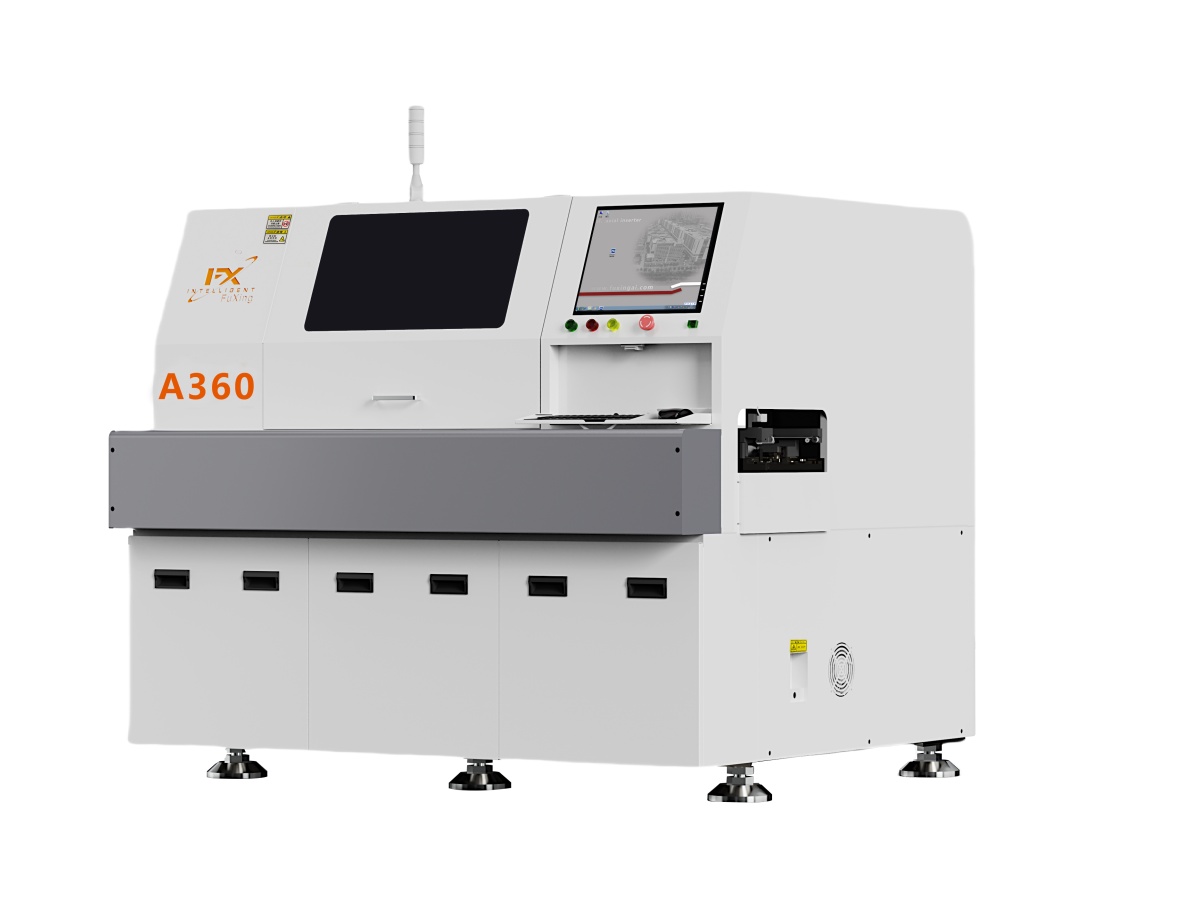
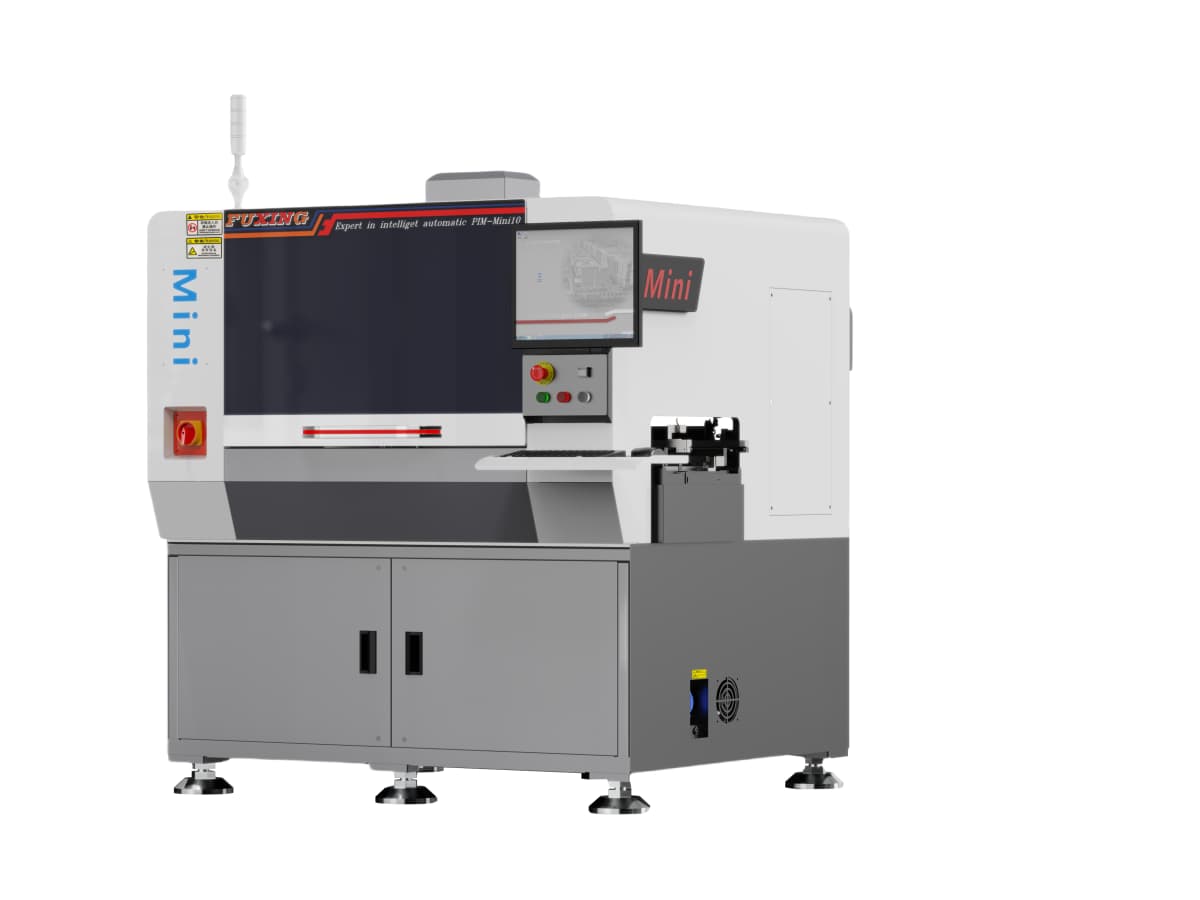
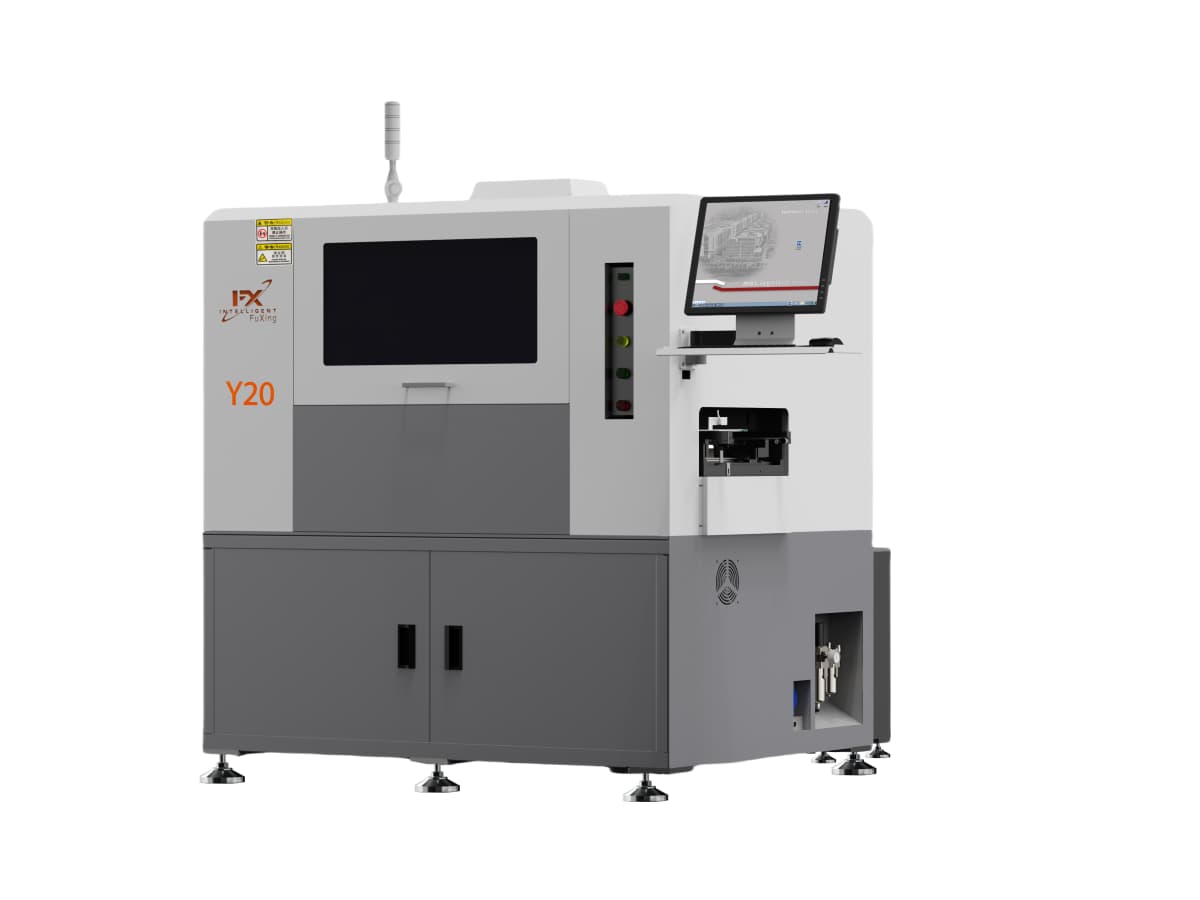
Before asking about cycle time, settle these. One, the compliance travel in millimetres and whether springs can be swapped by component size. Two, whether force monitoring exists, the adjustable threshold range, and whether an over-limit event stops the machine or only alarms. Three, the adjustable insertion depth range and whether it covers 2.0mm board. Four, maximum component weight and envelope, where the Y series reads 150g suction, 200g gripping and 40mm in length, width and height.
Cycle time is the least useful thing to argue about. Automotive batches are usually modest, a few thousand boards a day at most, and a vertical inserter at 0.16 to 0.2 seconds per point, roughly 20,000 an hour, covers that comfortably. What stops a line is insertion defects and rework, not three seconds of speed.
This is more useful than a model recommendation.
Press-fit connectors: no. The connection principle is different, it needs dedicated press-fit equipment, and an inserter does not have that force control.
Large relays and fuse blocks: mostly no. Weight and volume exceed the gripping limit, and insertion force is high enough to damage the board. If they must be automated, the only route is an odd-form inserter with mechanical grippers, half the speed but able to hold the part.
Connectors with locating pegs: depends. The peg has to press into a locating hole, which demands both perpendicularity and controlled force, and a standard insertion head does not do it well.
What remains, resistors, capacitors, diodes, transistors and optocouplers on tape, is the inserter's home ground. On automotive boards that is sixty to seventy percent of the points.
Do not use a demonstration board. Use a real automotive board from your own line.
First, insert a hundred points and inspect every barrel. Under a magnifier or microscope, look for lifted plating and cracks at the hole mouth. This is the most direct check on whether compliance and the hard stop are set correctly.
Second, create a fault deliberately. Block one hole with a little solder debris and see whether the machine stops. That test separates real force monitoring from decoration.
Third, run two hours without touching parameters and watch whether the defect rate holds. Parameter drift is a common complaint on insertion machines, especially in shops with unstable air pressure.
Those three tests say more than the accuracy figure on a brochure. A repeat positioning accuracy of 0.01mm means the head arrives where it was told, not that the insertion is harmless. For sustained running, spare parts stocking for compliance springs and grippers has to keep up, since those are exactly the parts that shape that one press.
Q1: Does an automotive insertion machine have to be imported?
It depends on the process. For ordinary taped component insertion, domestic machines are adequate on accuracy and cycle time, and the 0.01mm accuracy and 0.3 percent defect rate published on this site sit in the front rank of domestic equipment. Press-fit and large connectors are a different equipment category with fewer domestic options, and need separate evaluation.
Q2: Is there any standard for insertion force at all?
The industry has no universal number to quote. What can be relied on is the result: no barrel damage after insertion, no bent leads, no unsoldered or voided joints after wave soldering. Inspect against results, not against a figure.
Q3: Can a standard inserter handle 2.0mm board?
Usually yes, subject to the adjustable insertion depth range and the lead cutter stroke. Some machines are designed around 1.6mm, and on 2.0mm board the leads protrude too little and cutting is incomplete. Trial insert on your own board before buying, not on the brochure.


Copyright © 2002-2026 Shenzhen Fulxing Intelligent Equipment Co., Ltd. All rights reserved. ICP License:
Service Hotline