Welcome to Fulxing Intelligent - SMT Automation Equipment
 简体中文

Customer Service Hotline
18565526634
Welcome to Fulxing Intelligent - SMT Automation Equipment
18565526634
Contact: Mr. Yang
Mobile: 18565526634
Tel: 18565526634
Email: 1404870852@qq.com
Address: Songyu Rd 142, Songgang St, Bao'an Dist., Shenzhen, China
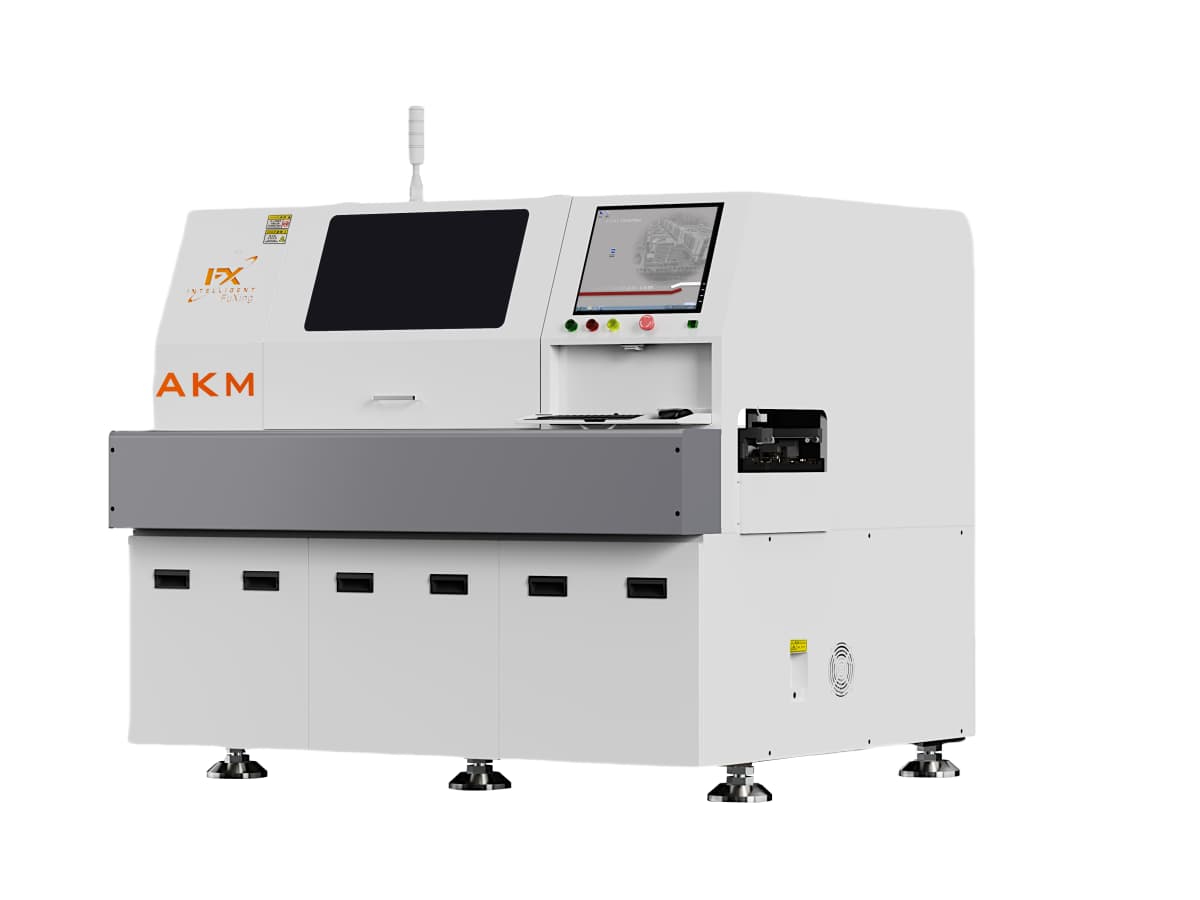
Configuring a power tool control board insertion machine works the opposite way to a home appliance board. An appliance board carries about 200 points and taped small parts account for seventy percent of them, so one vertical machine absorbs most of the output. A power tool board carries fifty or sixty points, of which only around twenty are taped. The rest are power devices, inductors, fuse holders and terminals. Configure it like an appliance board and the main machine sits idle while the heavy parts stay manual.
The difference comes from what the board has to do. A power tool runs high current for long periods and has to survive vibration, dust and outdoor temperature swings, so the board can only use thick-leaded devices and heavy copper traces. Heavy traces mean large pads and large holes, and components seated in a hole that big will shift. Every one of those consequences lands on the insertion process.
A typical lithium battery drill or angle grinder control board looks like this:
| Category | Components | Assigned to |
|---|---|---|
| Power devices | TO-220 through-hole MOSFETs, Schottky diodes | Odd-form or manual |
| Magnetic parts | Large inductors, toroids, common mode chokes | Mostly manual |
| Protection | Fuse holders, blade fuses | Odd-form or manual |
| Connectors | Battery, switch and motor terminals | Manual |
| General parts | Electrolytics, resistors, ceramic caps, LEDs | Vertical, on tape |
| Sensing | Thermistors, shunt resistors | Vertical, on tape |
Taped parts are only the last two rows, twenty points or so. Everything above them is awkward for a machine. That is why judging capacity from point count alone goes wrong.
A TO-220 lead is flat, 0.5 to 0.8mm thick and about 2.5mm wide, with three leads in a single row. Insertion grippers are designed around round leads. Grip a flat lead and it slips; grip harder and the lead face takes a mark. A marked lead actually solders worse at the wave.
Seating is the harder problem. High current boards run hole diameters of 1.2mm to 1.5mm, well above the lead, so the component sits loose. The moment the gripper releases, the part tilts or lifts. A lifted part has no solder at the lead root after the wave, passes electrical test, and opens up after a few vibration cycles in the tool.
The practical answer is a press foot after seating, or an operator straightening by hand. Plenty of shops simply keep these parts manual, using a fixture for location and pressing by hand, slower but consistent. An odd-form machine with mechanical grippers can do it, provided the grippers are built for flat leads, which costs a few thousand yuan and only pays where the component range is stable.
Power tool boards often use aluminium substrate or 2oz and 3oz copper to move heat out. Good for the power devices, awkward for wave soldering.
Aluminium conducts heat away so fast that preheat never reaches the pads, and cold joints and bridges follow. Heavy copper behaves similarly: more copper absorbs more heat, and preheat settings that work on a standard board fall short. These boards need their own preheat profile, and sometimes more flux.
None of this involves the insertion machine, but it decides one thing: change the board material and both insertion and soldering parameters have to be re-set. Buy a machine after trialling it on ordinary FR4 and the first aluminium batch will catch you out. Bring the real board, and bring the hardest one.
Standard board is 1.6mm; power tool boards go to 2.0mm for vibration resistance and heat spreading. A thicker board leaves less lead protruding after insertion, which affects both cutting and solder uptake. Machines with adjustable insertion depth cope; those without either cut short or cut into the pad.
Thicker board also means a heavier panel. On a machine whose rail clamping is marginal, the board shifts slightly during insertion, and across a few dozen points the accumulated error reaches a fraction of a millimetre. No single point looks out of tolerance; the assembly will not fit the housing.
Classify by component before counting capacity. Take 3,000 boards a day at 60 points each, 20 taped and 40 large.
Taped parts come to 60,000 points. A vertical machine at 0.18 seconds per point and 70 percent utilisation delivers roughly 14,000 an hour, so four to five hours covers it, one machine, with headroom left for other work.
Large parts come to 120,000 points a day, which no odd-form machine absorbs either. At 0.4 seconds per point an odd-form runs about 6,300 an hour, so a full day yields 50,000. The remaining 70,000 points go to manual stations, or the design changes.
So the realistic layout in a power tool plant is one vertical inserter on taped parts, one odd-form inserter on the power devices and fuse holders it can handle, and several manual stations for terminals and magnetics. That ratio is the reverse of an appliance plant, where the vertical machine leads and the odd-form fills gaps.
Whether the odd-form is worth buying comes down to three numbers: more than eight TO-220 devices per board; a power device range that does not change three times a year, or custom grippers never pay back; and the terminal count, since terminals are essentially manual and only a real count shows the true labour cost.
Do not use the demonstration board. Bring the hardest board you make, the aluminium or heavy copper one, the 2.0mm one.
One, check whether the seated power devices lift. Measure the gap between the body underside and the board surface with a feeler gauge; anything above 0.3mm needs an explanation. Two, check the flat leads for gripper marks. Three, run fifty boards and check accumulated drift by stacking the first and last and holding them to the light to see whether the holes still line up.
Those three matter more than cycle time. A second per point costs little over a day. Lifted parts and drift scrap whole batches.
Q1: With so few points, is a MINI inserter enough for power tool boards?
For taped parts, yes. For large parts, no. The MINI targets small boards and small batches, with span range and grippers built for small components, so TO-220 devices and inductors largely will not run. If the large parts were going manual anyway, a MINI is a reasonable start.
Q2: Could the power devices become SMD and skip insertion entirely?
They can, and plenty of new designs do exactly that. Where current is high and heat has to be spread, though, a through-hole part with a heatsink still has an advantage, especially where the structure needs mechanical fixing and grounding. Whether to redesign is a product decision, not an equipment one.
Q3: Can aluminium boards go through wave soldering?
Yes, but the preheat profile has to be set separately, and not every flux suits it. Before buying, ask whether the supplier has actual aluminium board cases and have them explain preheat temperature and conveyor speed. A supplier who has only run FR4 will need several attempts on their first aluminium board.

Copyright © 2002-2026 Shenzhen Fulxing Intelligent Equipment Co., Ltd. All rights reserved. ICP License:
Service Hotline