Welcome to Fulxing Intelligent - SMT Automation Equipment
 简体中文

Customer Service Hotline
18565526634
Welcome to Fulxing Intelligent - SMT Automation Equipment
18565526634
Contact: Mr. Yang
Mobile: 18565526634
Tel: 18565526634
Email: 1404870852@qq.com
Address: Songyu Rd 142, Songgang St, Bao'an Dist., Shenzhen, China
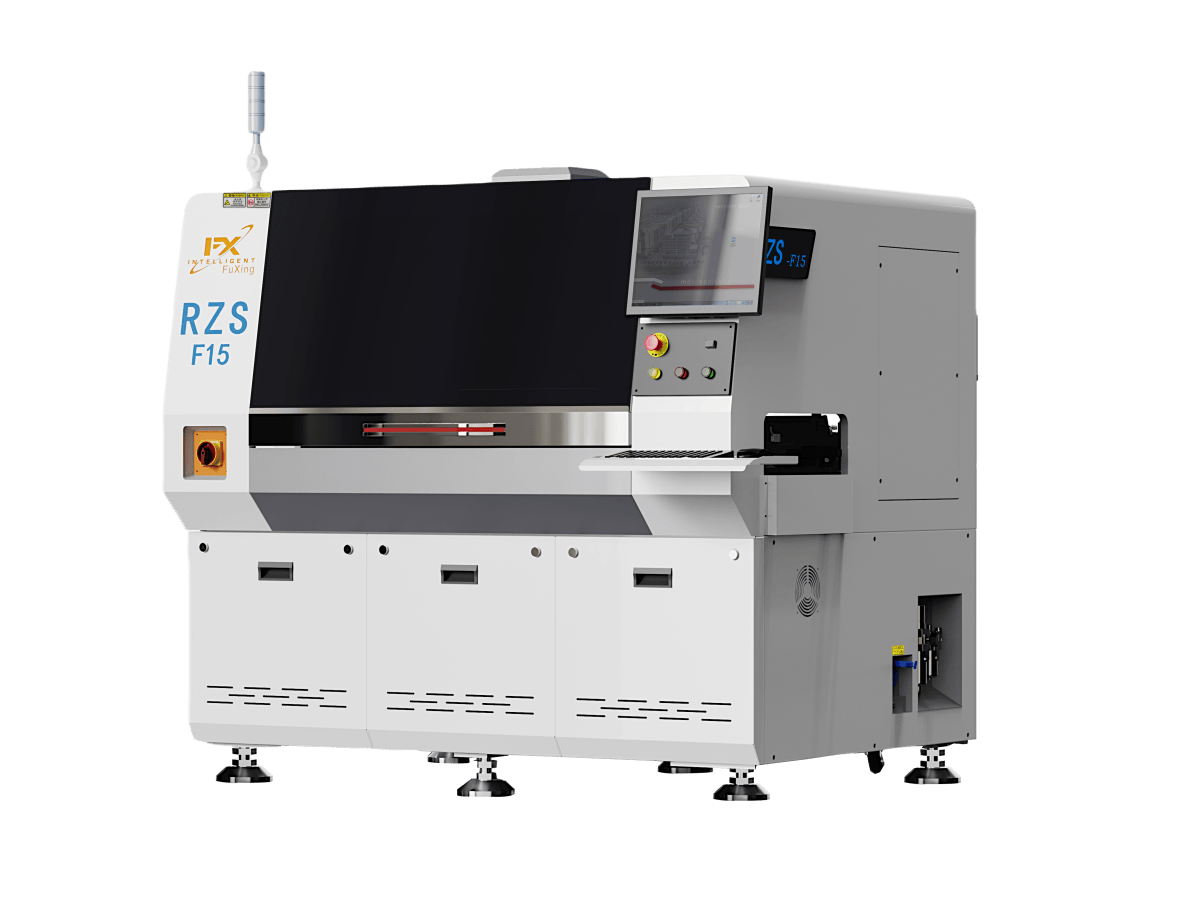
Judging an induction cooker control board insertion machine by point count goes wrong. A main board carries around a hundred points, which looks like a single vertical machine's workload. In practice the bottleneck sits elsewhere: the board is single-sided, every trace crossing is bridged with a jumper wire, and once jumpers dominate, the workhorse becomes a horizontal machine.
A double-sided board connects its two layers through vias. Where traces cross, you drill and route to the other side. A single-sided board has one copper layer and no vias, so when two traces have to cross, one of them goes over the other. That bridge is the jumper wire.
Single-sided is not a technology lag, it is arithmetic. One board per cooker, hundreds of thousands of units a year, and single-sided stock costs over thirty percent less. The price is jumper count, and fifteen to twenty-five per board is ordinary.
There are two ways to make the jumper. A zero-ohm SMD resistor, placed by the SMT line, handles short crossings. A through-hole jumper is tinned copper wire cut to length, bent at both ends and inserted into two holes, and long crossings can only use that. This is horizontal inserter work.
Inserting resistors, the component queues on tape, the head takes one and places it, span fixed. Jumpers are different because span is a variable.
One board carries jumpers spanning two positions, five positions, a dozen. Lengths run from 5mm to 30mm. The machine has to cut to the programmed length, bend, and insert. That is the jumper sequencing function, separate from the component sequencer, and combined machines carry both.
Three numbers tell you whether a horizontal machine can run the board: the shortest cut, the longest cut, and whether the cut end matches the hole. Get those wrong and the jumper either will not enter or enters crooked. Brochures say "jumper capable" and stop there.
Wire gauge matters too. Jumpers on high-current paths need to be thicker, and a thin wire spanning more than 20mm sags and bends the moment the gripper closes. Ask for the wire range the machine accepts before committing.
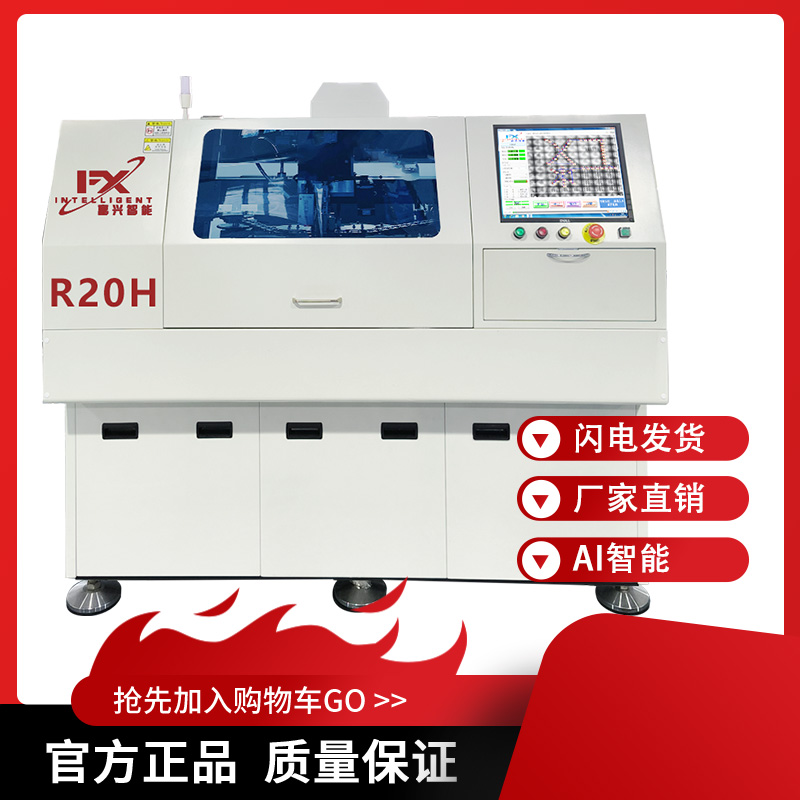
This is where single-sided boards bite, and where most first-timers get caught.
A double-sided board has plated barrels. The plating shares the lateral load when a lead enters. A single-sided hole is bare drilled laminate: no copper in the barrel, so vertical and lateral force land entirely on the pad. The pad is copper foil bonded to substrate with limited peel strength, and one slightly off-centre stroke lifts it. Sometimes the whole pad comes away.
A lifted pad will not take solder at the wave, inspection catches it, and by then the batch is scrap.
Two requirements follow. The insertion head needs enough compliance travel to unload the moment a lead meets the hole edge. And the board needs support underneath so it cannot flex downward. Some shops add support pins between the rails, positioned to the board size.
The IGBT comes first. An induction cooker IGBT carries a heatsink, usually a TO-220 or larger package, thick leads at a narrow pitch. Most shops keep it manual and press it with a fixture.
The coil terminal is second. It is a tab terminal, not a round lead, and grippers cannot hold it.
The bulk capacitor is third. The 1200V class filter capacitors are large in diameter and exceed a vertical machine's gripper opening.
What remains machine-capable is the taped layer, resistors, diodes, ceramic and monolithic capacitors, transistors, small electrolytics, plus the jumpers. So the real requirement is two machines: a vertical for taped parts, a horizontal for jumpers.
Take a 100-point main board: 70 points of taped parts, 20 jumpers occupying 40 holes, 10 points manual.
At 3,000 boards a day, taped parts come to 210,000 points. A vertical machine at 0.18 seconds per point and 70 percent utilisation delivers 14,000 an hour, so fifteen hours, more than one machine can do in a shift.
Jumpers run 20 per board across 3,000 boards, 60,000 holes, which at two points per jumper is 30,000 points. A horizontal machine at 20,000 an hour clears it in two.
The arithmetic is counter-intuitive: jumpers occupy fewer points, yet the vertical machine needs fifteen hours. Real lines run one vertical plus one horizontal machine, and the horizontal still has spare capacity. Some shops run both in parallel and bring total time down to seven or eight hours.
Below 1,000 boards a day, a vertical plus a horizontal is clearly oversized. Then one horizontal machine handles jumpers and the axial taped parts, the vertical stays off the floor, the rest is manual, and the vertical is added when orders grow.
Change the cooker model and every jumper position moves. This is not a matter of editing a few coordinates; lengths, spans and insertion order all get re-sequenced.
A re-sequence takes a competent operator half an hour to an hour. If the program is stored, switching back takes ten minutes. So ask how many programs the machine holds, which matters more than cycle time for a shop with many models.
Cut wire ends also drop into the machine and eventually jam the mechanism. Clear them once per shift rather than waiting for an alarm. In the spare parts list, feed gears and cutters are the high-wear items on this kind of machine, and stocking by insertion count beats stocking by calendar.
Q1: Could the board go double-sided to eliminate jumpers?
Technically yes, commercially no. Double-sided stock and processing cost more, and induction cooker boards are not small, so the saving in jumper labour does not cover the board premium. Unless there are high-frequency or high-current constraints, single-sided with jumpers stays the norm.
Q2: Can zero-ohm SMD resistors replace all jumpers?
Short crossings, yes. Long ones, no. The largest 0-ohm package reaches nowhere near a 20mm span, so distant crossings still need wire jumpers, and that is why horizontal machines still sell.
Q3: How do you tell whether pads will lift on a single-sided board?
Insert a hundred points, then inspect the pad edges under a magnifier. Lifting or whitening means excessive force or insufficient support. Scrape a pad lightly with a fingernail; if it lifts, adhesion is already compromised and the insertion parameters need resetting.

Copyright © 2002-2026 Shenzhen Fulxing Intelligent Equipment Co., Ltd. All rights reserved. ICP License:
Service Hotline